
ON THE HORIZON 2025 | Trenched in Delay: When is the 'reasonable time' to use a standard form contract in Offshore Construction?

December 2025 Edition
Lessons learned from Pharos Offshore Group v Keynvor Morlift Limited
Complex infrastructure and engineering projects come with risk, especially offshore. This was illustrated by the recent case of Pharos Offshore Group v Keynvor Morlift Limited. The case is most notable for the number of practical issues that it addressed. For the purpose of this article, we are going to focus on some of the practical take aways arising out of one of the main issues in dispute, namely the issue of programme and delays, and we will consider how the use of standard form contracts with detailed provisions for completion and extension of time might assist parties.
The Facts:
This case relates to the Viking Link Project, an electricity link transporting power between the UK and Denmark.
The claimant, Pharos Offshore Group (Pharos), provided jet trenching equipment to the defendant, Keynvor Morlift Limited (KML). KML had been engaged by Prysmian Powerlink Srl (the main contractor of the Viking Link Project) to undertake various services in connection with the project, including the burial and embedment works of the electricity cable. To undertake that work, KML needed to utilise Pharos’ jet trencher.
The central issue of the dispute relates to the duration of the works, the cause of delay in completing the works, and who was responsible for the cost and time associated as a result.
The parties contracted on the basis of three purchase orders which were subject to, and incorporated, KML’s standard terms and conditions. The purchase orders, together with the terms and conditions was the “Contract”.
Crucially, as will become clear later in this article, the scope of work contained in the purchase orders stated that the works would be undertaken in accordance with an “indicative programme.”
Prior to commencement of the works, the parties engaged in scheduling discussions with a planned mobilisation date set for 9 June 2022. However, the equipment faced UK export delays between 6-17 June 2022, and the equipment arrived in Denmark on 20 June 2022 with works commencing on 23 June 2022.
Execution of the burial and embedment works were faced with operational difficulties and delays (including weather and sea-state conditions), causing significant downtime. The works were not completed until 18 August 2022.
In response to those delays, KML attempted to withhold sums invoiced by Pharos for the hire of its equipment on the basis that Pharos was only entitled to payment of daily charges for 10 days per the terms of the purchase orders, and no more for any period of delay thereafter.
KML counterclaimed c. GBP 1.2million in respect of additional vessel spread/hire by way of damages, and/or liquidated damages of GBP 185,280.
Was there a fixed time for completion?
KLM argued that there was a fixed time for completion, which in turn capped Pharos’ ability to recover payment to 10 days. Pharos contended on the other hand that the time was not fixed and that the time was “indicative”, although they accepted that they would have to complete within a reasonable time.
The Court’s decision:
The court agreed with Pharos and held that, objectively, the number ‘10’ within the Contract was an indicative number representing the parties understanding of the likely duration of the works. It was not intended to be a fixed and/or firm number of days within which Pharos were contractually obligated to undertake the works.
In coming to this decision, the court relied on the fact that the programme was expressly stated to be “indicative” and that it would be “wholly inconsistent” to state that the number of days would be fixed. The court also recognised that the parties – with knowledge and experience of offshore projects - would have been aware that the actual conditions encountered would affect the performance of the trenching equipment and could change due to external factors (i.e., weather and sea state conditions).
But then comes the question: what is a reasonable time for the works to be carried out?
The court held that a “reasonable time” cannot be considered in the abstract but is to be assessed by means of a broad consideration, with the benefit of hindsight, of what would have been a reasonable time for performance when all of the relevant circumstances had been considered. Those circumstances would include, for example: any estimate of how long Pharos would take to perform; whether that estimate had been exceeded and, if so, in what circumstances; the causes of delay and the extent to which that delay was in Pharos’ control.
Would a standard form contract have been a better option?
Carrying out such an exercise at the end of a project involves uncertainty for the parties during the project and means that by the time an assessment is made, evidence may be unavailable or limited.
The benefit of standard forms in these circumstances is that they have mechanisms to address issues of delay during the project. Forms such as FIDIC, NEC, and LOGIC include clear extension of time procedures that require contemporaneous assessment of delay events, allowing parties to understand their time-related obligations and liabilities in real time rather than retrospectively.
These mechanisms require the parties to document delay events as they occur and avoids surprises at the end of the project. Moreover, they provide contractual certainty: the contractor knows when completion is required, the employer can plan accordingly, and both parties can make informed commercial decisions about acceleration or mitigation measures.
The retrospective "reasonable time" assessment by contrast forces parties to operate in uncertainty throughout the works, unable to definitively determine whether they are in breach or entitled to additional payment until months or years later when a tribunal makes its determination. This uncertainty hampers effective project management, complicates cash flow planning, and often leads to disputes that could have been avoided through proper contractual time management mechanisms operating contemporaneously with the works themselves.
How do you choose a suitable standard form contract for an offshore project?
There are a number of standard forms to choose from, all with different strengths and weaknesses. The most commonly used offshore are LOGIC and FIDIC, though NEC is gaining popularity internationally. However, of these three, only LOGIC is specifically drafted for offshore projects – FIDIC and NEC both originate from onshore construction. The choice often depends on factors such as project type, financing requirements, the parties’ familiarity with particular forms, and whether the contract is for the main works or a discrete subcontract package. The following table compares some of the key features of each of these forms and how they deal with time:
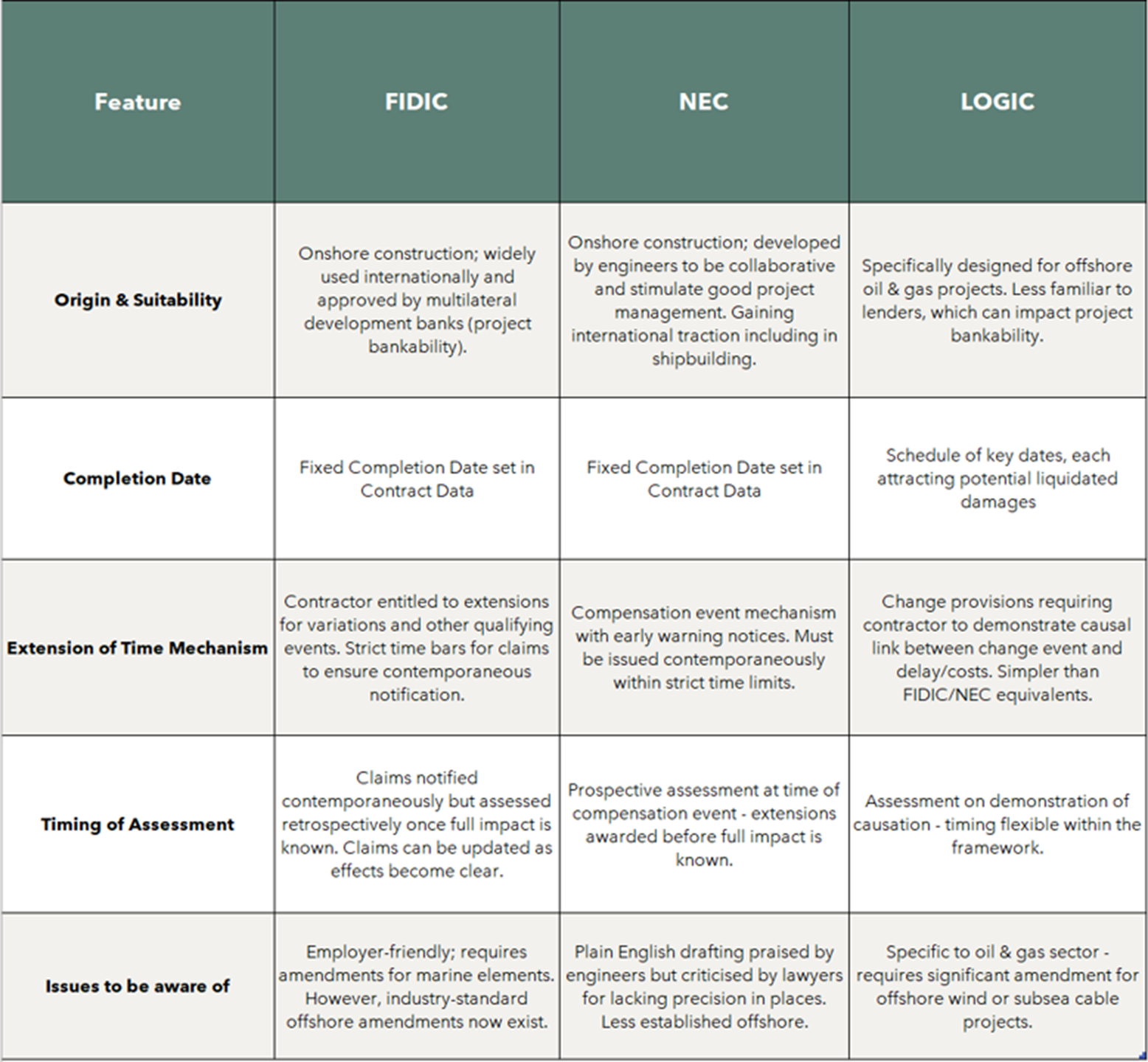
Both FIDIC and NEC offer short-form versions that could have been suitable for the discrete scope of work in the Pharos case and are generally more appropriate for subcontracting packages where full standard forms would be disproportionate.
Better options in the pipeline?
While FIDIC dominates offshore renewable projects and LOGIC remains popular in oil & gas, the industry is responding to the need for better offshore construction contracts. New forms specifically for offshore wind are expected from FIDIC, LOGIC, and BIMCO in 2026, and IMCA has already published its Marine Transport & Installation Renewables Contract. For these new forms to gain wide adoption, they will need to balance offshore-specific provisions with accessibility - providing the certainty of proper time management mechanisms while remaining sufficiently streamlined for subcontracting packages.